What I learned from the first two chapters of Samuel
Lucky you! I have decided to give you a glimpse into my morning devotional readings. Haha!
Please be patient as I weave in and out of the narrative found only in the first two chapters of Samuel.
Mothers
We meet Hannah, the wife of Elkanah in the first chapter of 1 Samuel. Hannah is Elkanah’s favorite wife, but it says, “the Lord had closed her womb.” The Lord is the one who did that and Peninnah makes Hannah miserable because of it. She would provoke her so much that Hannah would weep and not be able to eat because of her infertility.
This pattern had already happened twice before this in Genesis. In each situation the rival resorts to torturing the other.
Abraham’s wife Sarah was the primary object of his affection and the recipient of God’s specific promise of an heir. But she is barren. After years of infertility, she resorts to the legal route of obtaining an heir for her husband. She gives Hagar to Abraham to bear a child on her behalf. But as soon as Hagar conceives Ishmael, we read that Hagar looks upon Sarah with contempt and ‘makes her life so miserable’ she is sent away.
In the flesh we would choose the younger and more fertile to bring forth the promised seed. But God favours the impossible choice of Sarah. God waited also waited until she was 90 when Paul says her womb was “as good as dead” Hagar meets the Lord in the wilderness but lets not go there this time for the sake of the length of this piece.
In Genesis 29 and 30 we have the story of Rachel and Leah. Jacob was “tricked” into marrying Leah first. When the Lord saw that Leah was unloved, he opened her womb; but Rachel was barren. Again, the womb of the ‘loved one’ is barren. Leah makes Rachel miserable and a fertility war ensues!
Peninnah was the model of success in Hannah’s story. She had the children, the status, and the “proof” of God’s favor in that culture. But God.
God chooses the woman who was “provoked to tears” and had nothing to offer but her despair and a vow.
In 1 Samuel 2: 1-10 we have Hannah’s prayer I see her as both fulfilled mother and prophetess as she sings her beautiful song.
The bows of the mighty are broken, but the feeble are girded with strength. The Lord humbles the proud and exalts the lowly. He raises the poor to sit with nobles.
She crowns the song with a prophecy in the final verse that foreshadows the Magnificat of Mary,
“Those who contend with the Lord will be terrified; Against them He will thunder in the heavens, The Lord will judge the ends of the earth; And He will give strength to His king And will exalt the horn of His anointed.”
Her song puts Paul’s dissertation of Sarah and Hagar in Galatians 4 in a most beautiful nutshell. In Galatians 4:21-31 Paul shows us the Sarah and Hagar narrative isn’t just a random history lesson. He tells us God consistently bypasses the obvious choice.
He seems to love creating situations that are impossible without Him.
The credit goes to the One who fulfills His promise, not biology. We are called children of the spirit children of the promise because of it. The product of the will of God not the will of man.
God’s power is made perfect in weakness
A Corrupt Priesthood
The offerings for the priests at that time were to be taken from the cooked portion of an animal AFTER the fat had been taken off to burn before the Lord.
It says in Leviticus that the burning of the fat of the sacrifice was pleasing to the Lord.
1 Samuel 2:15: “Also, before they burned the fat, the priest’s servant would come and say to the man who was sacrificing, “Give the priest meat for roasting, as he will not take cooked meat from you, only raw.” 16 And if the man said to him, “They must burn the fat first, then take as much as you desire,” then he would say, “No, but you must give it to me now; and if not, I am taking it by force!” 17 And so the sin of the young men was very great before the Lord, for the men treated the offering of the Lord disrespectfully.”
Phineas and Hophni did not only want to satisfy their own cravings, but they prevented the people from obeying God.
I saw something I had never seen before about the repugnance of their sins.
1 Samuel 2:22: ‘Now Eli was very old; and he heard about everything that his sons were doing to all Israel, and that they slept with the women who served at the doorway of the tent of meeting.
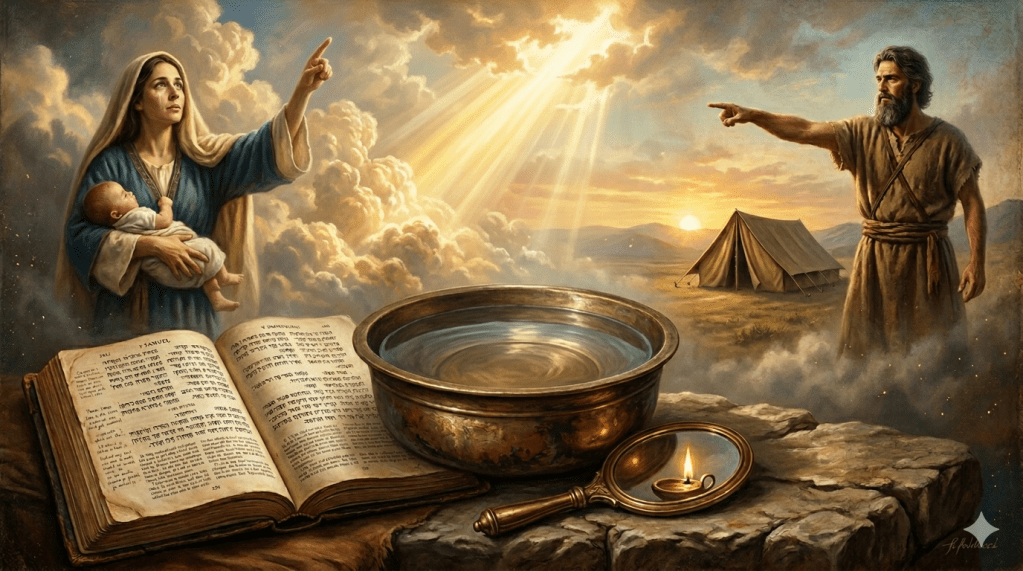
The cross reference for that verse was Exodus 38:8 Moreover, he made the basin of bronze with its base of bronze, from the mirrors of the serving women who served at the doorway of the tent of meeting.
The women who served at the doorway of the tent of meeting. Have you heard a sermon on that?
I have not. What was their job description? The tasks of the Levites were outlined in excruciating detail in Numbers and Leviticus but these serving women have only the two mentions I have given you.
In an effort to find out about them I read that the word used for them is ‘tsaba’ which means to serve, to assemble and to war. We can draw from this that these women were there likely organized and served on a rotating basis like the priests. That they were stationed at the “doorway” indicates they had some gatekeeping or crowd control duties. It has been suggested they wove and maintained the beauty of all the curtains and materials used to make the tent.
It is likely these serving women lived there. Perhaps they served in an intercessory role as well. In that context I think of Anna the prophetess mentioned in Luke 2 in a different light. She who ” was always at the Temple; she never left. She worshiped God by fasting and praying day and night.”
These are the women who donated the expensive bronze hammered into plates and highly polished to be used as their mirrors.
The mirrors, tributes to a focus on self and physical beauty were used to make the lavers (washbasins) to be used by the priests to wash their hands and feet after making sacrifice on the altar and before entering the Holy Place.
A necessary step in the protocol outlined by Moses as the proper way to approach the altar.
Before a priest could enter God’s presence he had to wash. To wash he had to look down into the water. Because the basin was lined with highly polished bronze (the donated mirrors) the priest would see his own reflection in the water as he cleansed himself. This reflects sanctification. You see the dirt you apply the water and you are made ready for the next level of intimacy.
The mirrors that were once symbols of self-focus became the very tools for self-examination and cleansing. I could go on a long time about mirrors! We are told to use the bible itself as a mirror that we should hold up to ourselves in order to be able to properly confess and repent of our sins.
But lets go back to 1 Samuel. In When Hophni and Phinehas violated these women at the doorway; they weren’t just committing adultery they were desecrating the very place they were meant to confront and repent of their sin.
In stark contrast to what I have mentioned about the wonderful role these serving women played we have Hophni and Phineas violating these women. Instead of ‘coming clean’ they abuse their power.
The sins of Eli’s sons weren’t just personal failures but systemic abuse of their power as leaders. A pattern we still see today. The current church coverups reveal an outright inability to deal with the same type of sin in church leadership. Sexual immorality, abuse of power and misuse of funds.
These are the time of our lives, that of the sons of Eli.
The Unnamed Ones
Of great curiosity to me was this sentence in 1 Samuel 2:27 we have an unnamed prophet or ‘man of God’ depending on your translation who comes to tell Eli his sons will both die on the same day and that the days of his leadership are numbered.
I have noticed this before, unnamed prophets.
These unnamed prophets and also those referred to not as prophets but described as ‘men of God’ or ‘ish ha- Elohim are mentioned 76 times about twelve men in in the Old Testament.
You can read about them in Judges 6:7–10 1 Kings 13:11–32 1 Kings 20:13, 22 1 Kings 20:35–4 and 2 Chronicles 25:15–16
In those references seven of these men of God are named and known to us like Moses and Elijah. The others though are unnamed and famous only as a direct representative of God carrying both authority and a specific heavy and pivotal message.
Platform is not the be all and end all.
Devotion to God and obedience to His commands is the most important thing whether other people know of your mission or not. Just as God chose the lowly Hannah, He uses the “unnamed” prophet to speak to Eli a man of high status.
These are some of the things I learned in my daily reading the last couple of days.
We can see our own failure, sin and experience of church reflected in many of the men and women of the bible. That God not only has mercy on us but loves us in the midst of that is miraculous to me.
I read Psalm 78 in conjuncture with the chapters in 1 Samuel. If you read it you might find the comfort there that found.
All the love my friends.
 lynnbusby.com
Leave a comment