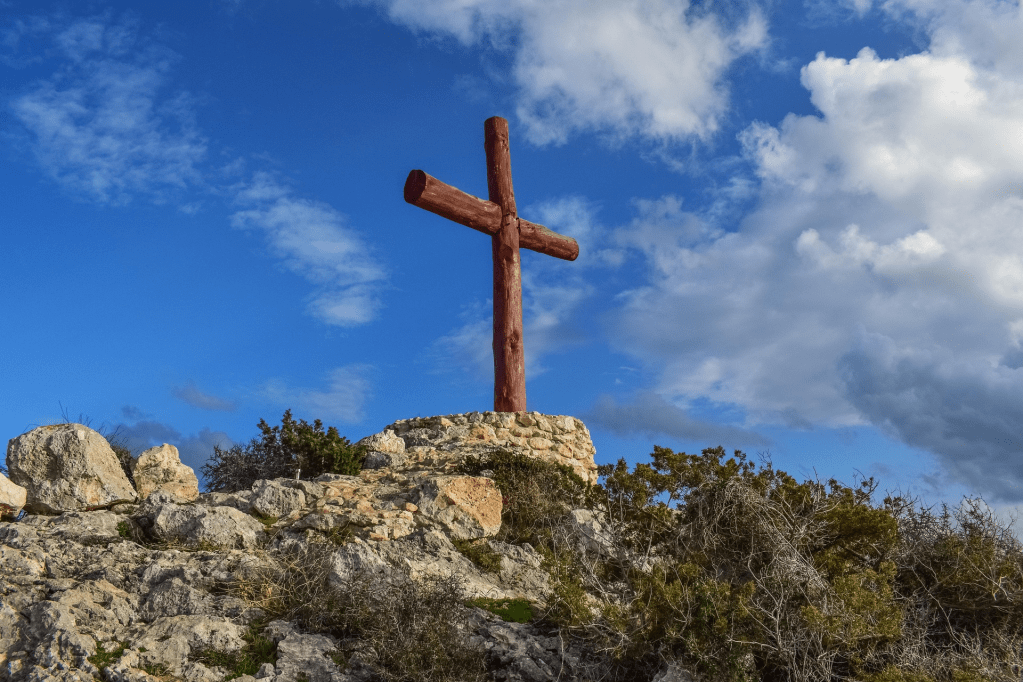
The highest place on earth we can ascend to is the feet of Jesus.
Noah’s sons were part of last week’s blog post, and it is striking how quickly, after the world had been destroyed by the flood, humanity returned to sin and idolatry.
Completely absent from that post was an essential paradigm we need to include in our understanding of where we are at this point. I mentioned our being in the times of Noah and days of the sons of Eli.
That is only one puzzle piece within the context of history. Humanity has been at war since God created man and placed him in the garden. A famous quote of Shakespeare says, “All the world’s a stage, and all the men and women merely players.” I would venture to say it is not just a stage but a theatre of war.
The way we frame our understanding of the world and its history is an important part of theological paradigm. It seems most of us believe the will and actions of humankind are at the centre of the play in the theatre of life.
We either do not believe in a spiritual realm or are completely occupied in it.
Humankind is so proud. Most believe the powers and principalities talked about in the Bible occupy an alternate realm and are for the most part observers of the geographical wars over the ages. They perhaps lie in wait for opportunities to get in the fight and trip us up. But we see ourselves as the major actors, the important players.
I have been ruminating on it this week and now see a continuum through every era.
This post will take a look at the way we engage in the theatre of the wars of the ages.
In Genesis 11 we read that the descendants of Shem said, come, let us build ourselves a city, and a tower whose top will reach into heaven, and let us make a name for ourselves; otherwise, we will be scattered over the face of all the earth.
Pride and rebellion are clearly revealed in that statement, but so is idolatry, because their desire was not simply to build but to establish themselves in a place that belonged to God.
They desired to create a name and a security apart from Him.
If they could ascend into the heavens, they would in some way be like God.
In that era, people would build ziggurats. It was believed that heaven and earth met at the tops of mountains, which is why altars were built on elevated ground, the high places.
Then in Genesis 28 we read of Jacob’s dream, where he sees a ladder, or stairway, reaching from earth to heaven, with angels ascending and descending on it. God Himself appears and reaffirms His covenant promises to Abraham.
In this, God shows that the ladder is not something to be worshipped, like the snake on a pole but a means of communication initiated by Him.
He assures His presence is not confined to heaven, nor is it inaccessible.
The picture reveals His desire and His readiness to bridge the gap between heaven and earth.
But God’s people did not seem to want Him, and they continually returned to idolatry.
As we move into the book of Judges, we see a pattern repeated again and again.
God’s people turn away, and suffering follows. Then they cry out, and God raises up a judge to deliver them.
It happens so often that there is a clear pattern.
Blessing, then idolatry.
Idolatry, then suffering.
Suffering, then repentance.
Repentance, then deliverance.
Looking around at other nations, the people decided to ask for a king.
Thus, we move into the era of kings.
But as the Lord predicted, things do not improve.
Each king is faced with the same choice, to do evil or to fear the Lord.
And there is one detail that consistently reveals how God judges their rule, whether or not they removed the high places.
That choice becomes a kind of hinge between blessing and cursing. To leave the altars and Asherah high places standing is to allow what draws the heart away from God.
It opens the door to demonic influence and the multiplication of corruption.
In 2 Kings 18 it is said of King Hezekiah that he removed the high places, smashed the sacred stones, cut down the Asherah poles, and even crushed the bronze serpent that Moses had made, because the people had begun to burn incense to it. They even gave it a name.
That detail is sobering, because something God had once instructed became something they worshipped.
Instead of using it to point them to Him, they put it in His place, which is the essence of idolatry. The result of this idolatry was oppression.
In the very next chapter, the king of Assyria comes and openly mocks God.
2 Kings 19: 23 Whom have you taunted and blasphemed, and against whom have you raised your voice, and haughtily raised your eyes. Against the Holy One of Israel. Through your messengers you have taunted the Lord, and you have said, with my many chariots I went up to the heights of the mountains, to the remotest parts of Lebanon, and I cut down its tall cedars and its choicest junipers. I entered its farthest resting place, its thickest forest. I dug wells and drank foreign waters, and with the soles of my feet I dried up all the streams of Egypt.
The king’s words echo that ancient spirit behind the statement, intent on ascendancy.
That angel of light in Isaiah who says, I will ascend to heaven, I will raise my throne above the stars of God, I will sit on the mount of assembly in the remote parts of the north.
The Bible declares Mount Zion on the sides of the north to be the city of the great King.
Thus, the powers and principalities declare their intent on control in the affairs of men.
The war is on.
The enemy rails at God through the Assyrian king. But in the middle of that threat, Hezekiah prays. And God answers. He says, I have heard your prayer, and He delivers them.
Over time, though, the high places are rebuilt. Each generation seems to return to them.
From Saul onward, through what we call the historical books, we see the rise and fall of kings, most of whom are described as doing evil in the sight of the Lord, and the people bear the consequences.
Then come the prophets, five major and twelve minor, all carrying the same burden.
To warn, to call to repentance, and then either judgment or deliverance depending on the response.
God sends Elijah to confront Ahab in the midst of idolatry.
Isaiah speaks to corrupt leaders and people.
Jeremiah warns before destruction and exile.
Jonah is even sent to warn a pagan city.
What stands out is that in many of these cases, unlike the times of the judges, there is no initial outcry from the people that moves God to action.
The action is initiated by God through the prophets.
Why. Hear His heart.
In Deuteronomy 30: 11“For this commandment which I am commanding you today is not too difficult for you, nor is it far away. 12 It is not in heaven, that you could say, ‘Who will go up to heaven for us and get it for us, and proclaim it to us, so that we may follow it?’ 13 Nor is it beyond the sea, that you could say, ‘Who will cross the sea for us and get it for us and proclaim it to us, so that we may follow it?’ 14 On the contrary, the word is very near you, in your mouth and in your heart, that you may follow it.
Ezekeil 33: 11 ‘Say to them, ‘As I live!’ declares the Lord G od , ‘I take no pleasure at all in the death of the wicked, but rather that the wicked turn from his way and live. Turn back, turn back from your evil ways! Why then should you die, house of Israel?’ ‘
So, God sends prophet after prophet until the last book of Malachi in the mid fifth century.
Silence ensues for hundreds of years until Jesus presents Himself as the fulfillment of Jacob’s ladder, the true connection between heaven and earth.
Yes, Jacob’s dream was a prophetic picture of Jesus.
In John 1:51, Jesus says that the angels of God will ascend and descend on the Son of Man. He presents Himself as the fulfillment of that ladder, the true connection between heaven and earth.
John 14:6, He makes it unmistakably clear that no one comes to the Father except through Him.
The powers and principalities are not idly standing by watching the drama unfold.
Jesus came and died on the cross, was buried and resurrected to make us His people, His temple, the gate between heaven and earth.
There is still an enemy at that gate. He still beckons us to become like gods, to take control, which would actually put him in control.
The first commandment is that we shall have no other gods before Him.
God did not command that worship out of ego, conceit, or control but for our good.
He knows we empower the enemy of our souls when we worship idols.
Satan does not play fair or passively wait at the gate for opportunity. He actively resists us at our individual gates, at our city and church gates as well. We know from the book of Daniel that the battle extends over nations.
We do not wrestle against flesh and blood, and the demonic realm is intent on multiplying evil in the world.
Last week I talked about the need for repentance and the importance of the fear of the Lord within church leadership.
We also need to identify the work of the enemy and refuse to cooperate with him.
How can we stand at the gate and protect the city when we seek to ascend in the same way he did.
The high places are still with us. We think ourselves more highly evolved than the men and women who built ziggurats, when our whole society is idolatrous.
Incense was burned to other gods on the high places, but we are meant to be the incense of the knowledge of the true God in the world.
Many of us spend a lot of time resisting the devil but will be ineffective if we are not submitted to God.
The power is not in proclamation against them but in lives set free to serve God by the power of the gospel.
Our penchant to wander is not surprising to our Lord. He has made provision for it but to receive we kneel. He offers mercy for sin and grace to live surrendered.
The highest place in the world, high above all rulers in the heavenly places, is at the feet of Jesus.

 lynnbusby.com
Leave a comment